At the 2025 Tour de France, 17 out of 21 of the stage winners were CORE users. This usage saturation signals a clear direction for where elite performance preparation is headed. Where pre-season heat training was once applied sporadically, we’re now seeing widespread adoption across the entire pro peloton. Guided by real-time core body temperature data, performance coaches can precisely dose heat stress without compromising other priorities of training camp base preparation.
Why Heat Train in the Winter?
When you look at how teams are using pre-season heat training, two clear motivations emerge; short-term readiness and long-term performance development.
1. Preparing for Hot Early-Season Races
Races like the Tour Down Under and the UAE Tour are major early-season objectives that can define momentum for the year. And they’re typically hot.
Teams that arrive already heat-adapted have a clear advantage: improved sweat rate, increased plasma volume, and better thermal tolerance when conditions get extreme.
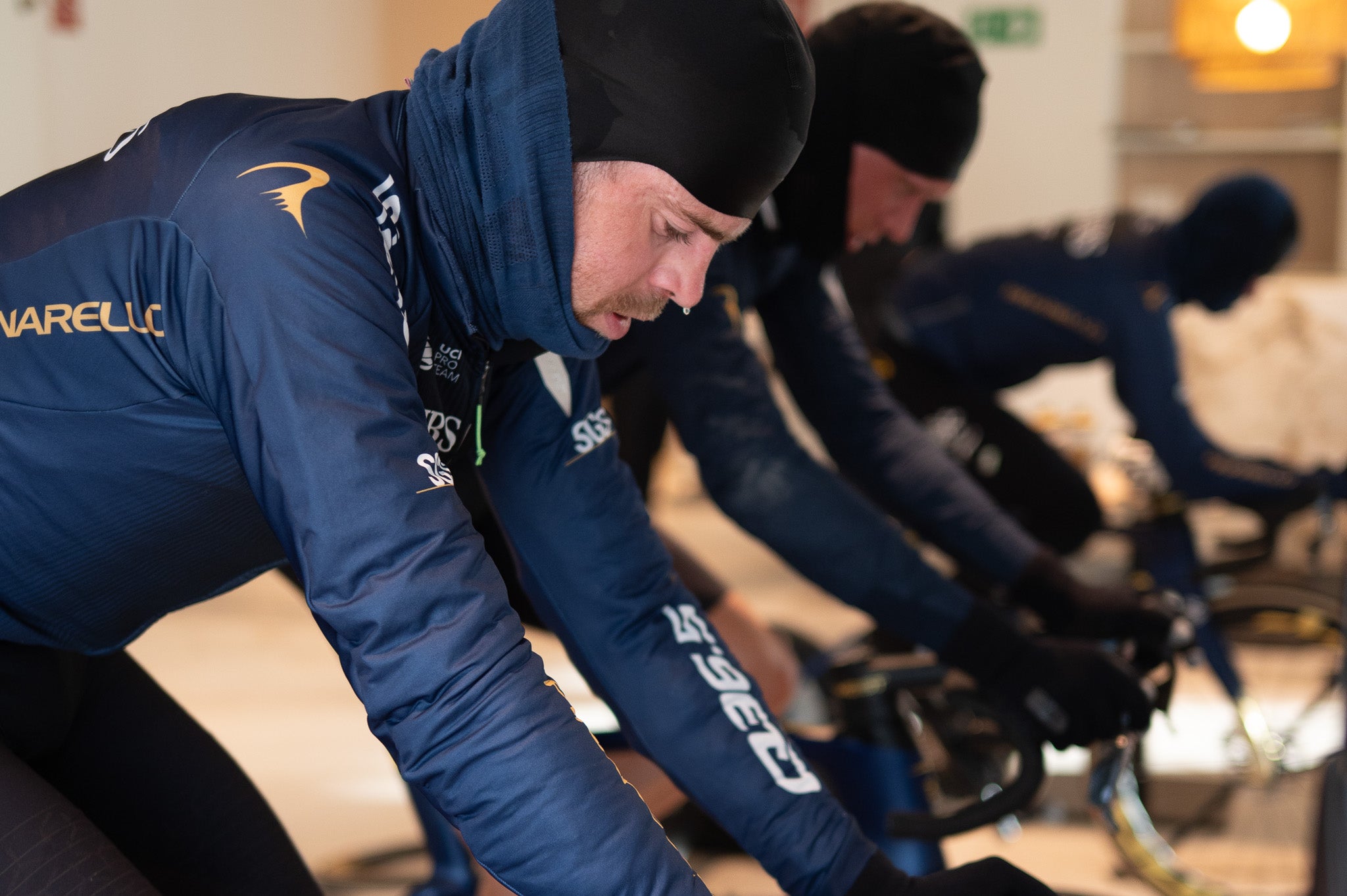
Team FDJ United Suez, for example, have already taken the first two stages in the Australian heat of Tour Down Under after executing a focused heat training block at their winter training camp. Lieselot Decroix, Head of Performance at Team FDJ United Suez, shared with us an exclusive look at their protocol:
- Heat session every other day
- 2.5 week block (8-10 sessions)
- Indoors in a CORE heat suit
- 5 min easy warm up
- 3x 5 min increasing power to reach Heat Zone 3
- Steady easy power for rest of session
By heat training during winter camps, athletes can arrive at these races with a meaningful level of heat adaptation already in place, rather than suffering through the climate differences.
2. Building Long-Term Performance Adaptations for the 2026 Season
The more profound shift, however, is why teams are committing to heat training months in advance.
Heat training is no longer viewed solely as a way to survive hot races. Teams are using it as a tool for general performance development as well as more strategic uses such as facilitating recovery and extending altitude benefits.
Well-controlled heat exposure has been shown to drive adaptations that extend far beyond thermoregulation, including:
- Plasma volume expansion
- Improved cardiovascular efficiency
- Enhanced endurance performance
- Increased VO₂max
In other words, heat training is being used as a force multiplier for traditional endurance training.
Beyond Heat Training
As the leading innovators in sports thermoregulation, CORE invests heavily into research and development, using their pro team partnerships as real-world proving grounds for discovery and innovation.
During this winter’s team camps, CORE has been working with teams like Pinarello-Q36.5 Pro Cycling Team to evaluate and refine the thermal properties of kit designs, ensuring efficient thermoregulation while balancing other critical priorities such as aerodynamics and comfort.
“The aim of achieving maximum performance is to manufacture the best possible garment that perfectly combines cooling for our cyclists with the best aerodynamic performance,” explains Pinarello-Q36.5 Pro Cycling Team Head Coach, Carles Tur. “In this regard, Q36.5 is a leading brand that pays attention to the smallest details and is at the forefront in both these areas.”
Additionally, CORE has been collaborating with some teams to better understand the relationship between recovery and performance by measuring off-bike activity.
CORE’s CCO, Ross McGraw, explains, “CORE is committed to decoding human physiology through the lens of thermoregulation and that extends well beyond time on the bike. Our partnerships with these pro teams give us an opportunity to expand our understanding of the relationship between performance and thermoregulation at the highest levels of sport.”
The Bigger Picture
When nearly the entire pro peloton commits to structured heat training months before the season begins, it represents more than a passing trend. It reflects a deeper understanding of how thermal stress can be strategically applied to build stronger, more resilient athletes.
Winter is no longer just about cold miles and base fitness. For the world’s top cycling teams, it’s also about getting comfortable being uncomfortable.
And the CORE 2 Thermal Sensor is becoming one of the tools that helps make that possible.